

Business Automation and Intelligence


Robotics Process Automation:
What is Robotic Process Automation (RPA)?
Imagine having a digital assistant that can take care of repetitive tasks for you, things like clicking through screens, entering data, or moving files from one system to another. That’s essentially what Robotic Process Automation (RPA) does. It’s a type of software that lets you create “robots” that mimic how humans interact with computers and digital tools.
These software robots can read what's on a screen, make the right clicks, pull out data, and follow instructions just like a person would. The big difference? They do it faster, more accurately, and without ever needing a break. That means your team can spend less time on routine work and more time on the stuff that really matters like solving problems, building relationships, and driving innovation, thus making their life happier and easier!!
But RPA is more than that :
While RPA started out as a way to automate simple, rule-based tasks (think back-office operations like data entry or invoice processing), it’s grown into something much more powerful. Thanks to advances in Artificial Intelligence (AI) technologies like machine learning (ML), natural language processing (NLP), and computer vision, RPA can now handle more complex jobs.
For example, it can:
- Understand and process documents intelligently
- Analyze communication patterns
- Support decision-making workflows
And now, with the rise of agentic automation (where AI agents take on more autonomous roles), RPA is evolving again. It’s not just doing tasks, it’s helping coordinate and secure entire systems of AI agents working together at scale.
Why It Matters for Your Business
At its core, RPA helps businesses work smarter. By automating repetitive workflows, it streamlines operations, cuts down on costs, and reduces the chances of human error. The result? Your organization becomes more agile, efficient, and profitable.
But it’s not just about the bottom line. RPA also makes work more enjoyable for your team. By taking the boring, repetitive tasks off their plates, employees can focus on more meaningful, creative, and strategic work, leading to higher satisfaction, better engagement, and increased productivity.
RPA is Fast, Flexible, and Easy to Implement. You don’t need to overhaul your entire tech stack to get started. In fact, RPA is perfect for automating processes that involve older systems like legacy software, virtual desktops, or tools that don’t have APIs or database access. And because it’s quick to deploy, it can accelerate your digital transformation without slowing down your day-to-day operations.
Choosing the Right RPA Technology
If you're thinking about scaling automation across your business, it's important to look beyond tools that only handle one or two tasks. What you really need is a complete RPA platform one that supports you every step of the way. From spotting the best opportunities to automate, to building and testing workflows quickly, to managing everything as your automation program grows.
The right RPA platform should:
- Make it easy to automate tasks across different teams and departments
- Keep your workflows running smoothly
- Give you full visibility and control as things scale
And as we move into a new era where AI agents, robots, and people work side by side, your RPA platform should also offer strong orchestration, governance, and security. That way, you’re not just automating you’re building a future-ready foundation.
So, what does Onelife.tech have to do with all these?
Whether you're just beginning your automation journey or expanding a mature program, having the right partner makes all the difference. At Onelife.tech, we help you choose and implement RPA solutions that are built to grow with you, securely, intelligently, and seamlessly. We provide enterprise-scale RPA platforms on-premises, on the cloud and even Hybrid. Additionally, we offer RPA as a service where you pay based on your consumption.
How does an RPA engagement with onelife.tech look like?
RPA Implementation is based on identifying suitable processes for robotics process automation. The implementation is not viewed as one huge project, but each process is treated as a mini project with relevant subject matter experts and implementation teams. This follows that if an organization identifies a hundred suitable processes for automation, then the hundred processes will need to be scheduled as mini projects in consideration of organizations capacity for concurrent project resources available.
A process is a set of interrelated or interacting activities that transforms inputs into outputs. The process consists of Inputs, Process Flows, Source Applications, and Outputs. The outputs of a process can serve as inputs for other processes.
The implementation is split into distinct processes mapped to specific businesses processes with standard operating procedures. A level of business process re-engineering can be achieved during the business analysis phase to ensure improvement and efficiency of the automated process rather than just automating As-is and hence automating in-efficiencies.
An Example of a process could be:
Order-to-Cash process description:
- A Purchase Order is received via email.
- The agent opens the email attachment and checks that the product code is present in the PO.
- If the product code is present in the PO, then the agent opens the ERP system and runs a specific ERP transaction.
- If the product code is not present in the PO, then the agent looks it up in the master data file.
- If the product code is present in the master data file, then the agent opens the ERP system and runs a specific ERP transaction.
- If the product code is not present in the master data file, then the agent sends out an email to the Master Data Analyst to update the file.
- Once the product code is provided, the agent populates the required fields in the ERP screen, as per the organization requirements and the PO.
- Next, the agent generates and validates the Sales Order.
- Finally, the agent replies to the initial email, adds the Sales Order in the attachment, and moves the email to the processed folder.
This further documented in an “As-is” process flowchart which could be as follows:
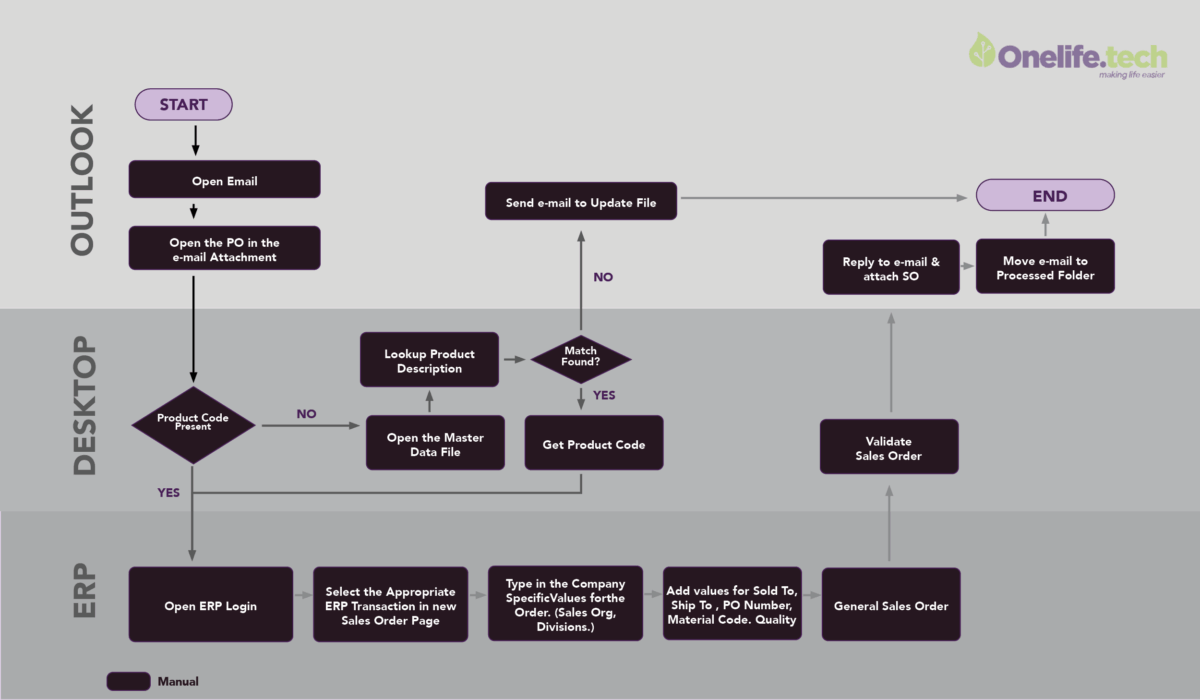
The As-is Process is analysed and documented in a “To-be” process flowchart identifying areas of automation:
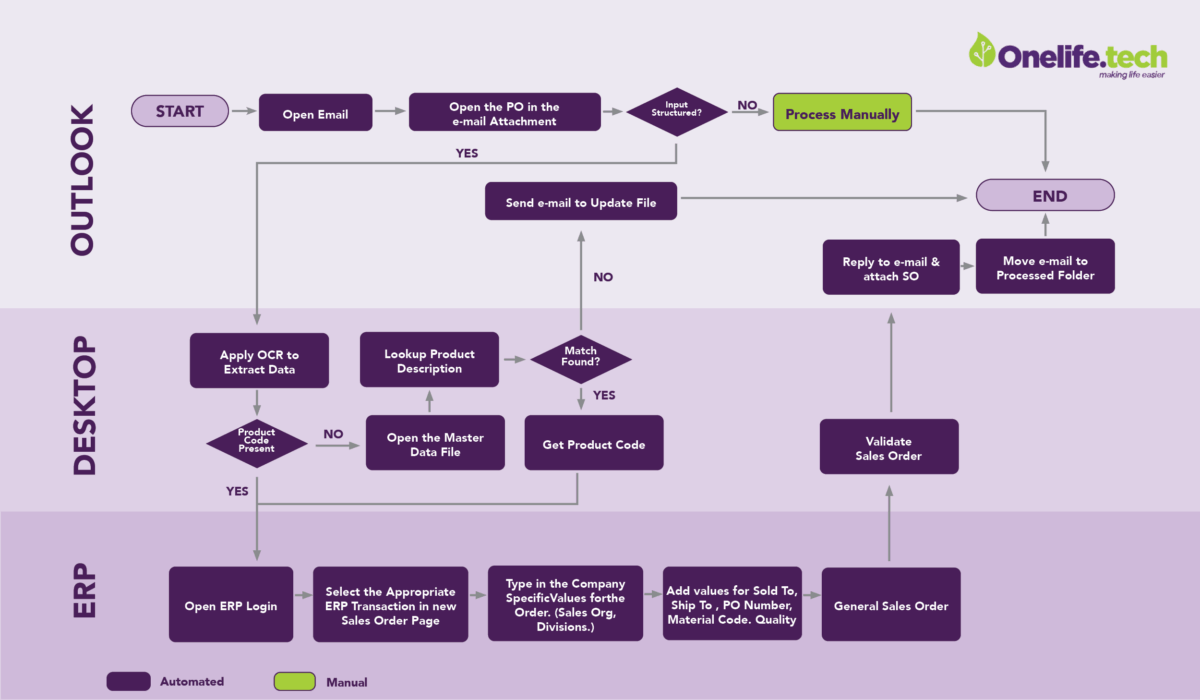
The implementation follows a structured process that outlines the stages involved in creating, deploying, and maintaining the deployed process, aiming to produce high-quality software Bots efficiently.
Onelife.tech RPA development Lifecyle is based on the software development lifecycle (SDLC) framework with the following high-level phases:
- Planning and Requirements Analysis: Defining the project scope, goals, and requirements.
- Design: Creating the architecture and design of the software.
- Development/Coding: Implementing the software based on the design.
- Testing: Ensuring the software functions as expected and is free of defects.
- Deployment: Releasing the software to users.
- Maintenance: Providing ongoing support and updates to the software.
Our RPA journey for each the processes will be as follows:
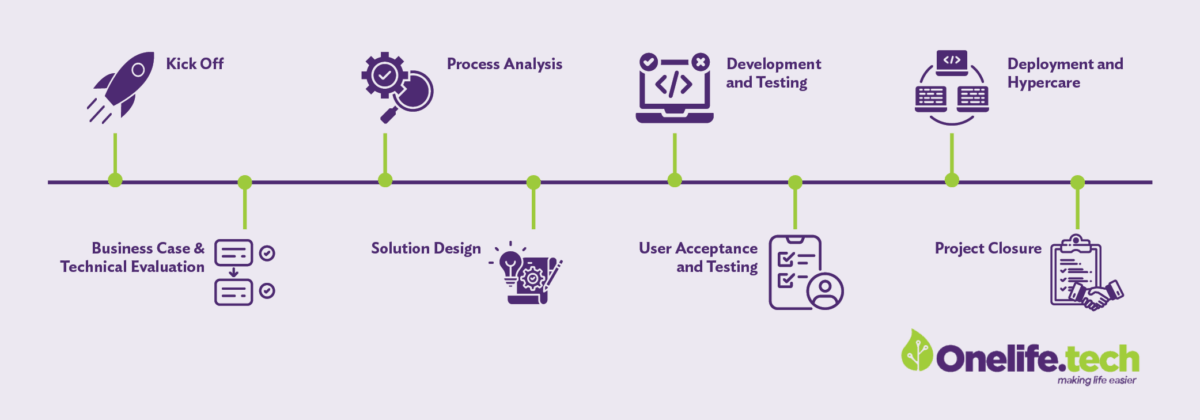
Phase 1: Kick-off
- Roles Involved: Solution Architect, Project Manager
- Tasks:
-
- Discuss automation readiness, including infrastructure, test and development environments, and test data/cases.
-
- Review the Statement of Work (SOW) and customer readiness checklist.
-
- Initiate an issue tracker and set up communication cadence.
- Inputs: Examine automation readiness, issue tracker.
- Outputs: Reviewed SOW, customer readiness checklist, initiated issue tracker, established communication cadence.
Phase 2: Business Case & Technical Validation
- Roles Involved: Solution Architect, Business Analyst, Project Manager
- Tasks:
-
- Collect automation ideas and assess their complexity and feasibility.
-
- Prioritize automation ideas.
- Inputs: Process Assessment tool, Opportunity Assessment Questionnaire.
- Outputs: Validated business case value and complexity, confirmed alignment with contract expectations, prioritized process assessment list.
Phase 3: Process Analysis
- Roles Involved: Solution Architect, Business Analyst, Project Manager
- Tasks:
-
- Analyze the current (As-Is) process.
-
- Create Process Definition Document (PDD) and test cases.
- Inputs: Process Assessment tool, Opportunity Assessment Questionnaire.
- Outputs: Defined and finalized the future (To-Be) process, completed and approved PDD, approved User Acceptance Testing (UAT) plan.
Phase 4: Solution Design
- Roles Involved: Solution Architect, Automation Developer, Project Manager, Business Analyst
- Tasks:
-
- Create a project plan and Solution Design Document (SDD).
-
- Provision developer and Subject Matter Expert (SME) software.
-
- Update the business case and create a Change Control process.
- Inputs: Process Assessment tool, Opportunity Assessment Questionnaire.
- Outputs: Completed SDD, Application Tracker, and Technical Testing Plan.
Phase 5: Development & Testing
- Roles Involved: Solution Architect, Automation Developer, Project Manager
- Tasks:
-
- Build the solution and conduct unit and integration testing.
-
- Perform code reviews and execute the Technical Testing Plan.
- Inputs: PDD, SDD, Application Tracker, Technical Testing Plan.
- Outputs: Built automation, completed unit and integration testing, code review.
Phase 6: User Acceptance Testing (UAT)
- Roles Involved: Solution Architect, Automation Developer, Project Manager, Business Analyst
- Tasks:
-
- Conduct UAT in coordination with the business team.
-
- Create a document for moving to production.
- Inputs: Process Assessment tool, Opportunity Assessment Questionnaire.
- Outputs: Executed UAT plan, client business team sign-off on test execution, completed Runbook document.
Phase 7: Deployment & Hypercare
- Roles Involved: Solution Architect, Automation Developer, Project Manager
- Tasks:
-
- Migrate final process packages and assets to the production Orchestrator.
-
- Provide monitoring and support.
- Outputs: Revised Runbook document completed production bug fixes.
Phase 8: Project Closure
- Roles Involved: Solution Architect, Automation Developer, Project Manager, Business Analyst
- Tasks:
-
- Confirm conformance of all services.
-
- Handover process for long-term support.
-
- Check and close financial loops.
- Outputs: Client sign-off on contract completion, initiated knowledge transfer, and document handover.
Phase 9: Continuous support
- Roles Involved: Solution Architect, Automation Developer, Project Manager, Business Analyst
- Tasks:
-
- Handle support incidences.
-
- Adopt the solution to application or systems changes.
-
- Monitor solution to ensure uptime and continuous value to the business.
- Outputs: Happy users.
How do you get value fast?
To ensure that the business gets value from the solution at the start and can scale effectively, we employ an Agile methodology. This approach significantly enhances the efficiency and scalability of the automation.
Benefits of Agile in RPA
- Flexibility and Adaptability: Agile allows for adjustments based on real-time feedback, making it easier to adapt to changing requirements and priorities.
- Faster Time-to-Value: By delivering automation in increments, organizations can realize benefits faster and continuously improve processes.
- Enhanced Collaboration: Agile promotes collaboration between business and IT, ensuring that automation solutions meet business needs and are technically sound.
- Risk Mitigation: Continuous testing and iterative deployment help identify and address issues early, reducing the risk of project failure.
Here’s is how we apply Agile principles to the RPA implementation:
-
-
Initiation and Planning
-
Sprint Planning: Break down the RPA project into manageable sprints. Each sprint focuses on specific automation tasks or processes.
Backlog Creation: Develop a backlog of automation opportunities, prioritized based on business impact and feasibility.
-
-
Process Analysis and Design
-
User Stories: Define user stories for each process to be automated, detailing the requirements and expected outcomes.
Collaborative Design: Engage stakeholders, including business users and IT, to collaboratively design the automation workflows.
-
-
Development and Testing
-
Incremental Development: Develop automation workflows incrementally, delivering functional components at the end of each sprint.
Continuous Testing: Integrate testing into the development cycle, ensuring that each increment is thoroughly tested before moving to the next.
-
-
Deployment and Monitoring
-
Iterative Deployment: Deploy automation solutions iteratively, allowing for adjustments based on feedback and performance.
Continuous Monitoring: Monitor the performance of deployed bots continuously, using feedback to refine and optimize the automation.
-
-
Review and Retrospective
-
Sprint Review: Conduct sprint reviews to demonstrate completed work to stakeholders and gather feedback.
Retrospective: Hold retrospectives at the end of each sprint to discuss what went well, what didn’t, and how processes can be improved.
Agentic Automation:
What is Agentic Automation?
Agentic automation is the next big leap in the world of automation. Think of it as giving software the ability to not just follow instructions but to actually think, decide, and act on its own.
Powered by advanced AI like large language models (LLMs), generative AI, and large action models (LAMs), these smart “agents” can:
- Understand their environment
- Ask questions
- Make decisions
- Plan and carry out tasks to reach a goal
And the best part? They don’t need people to guide every step. These agents can figure things out on their own spotting patterns, asking the right questions, drawing conclusions, and getting the job done from start to finish.
We’re not replacing RPA or traditional AI-powered automation, they’re still incredibly valuable. But agentic automation takes things further. It allows businesses to automate complex, unpredictable processes that used to be too tricky for automation.
That means:
- You can now fully automate end-to-end workflows
- Even those “long tail” tasks that were too unique or inconsistent before can now be handled by AI agents
Onelife.tech & Agentic Automation
At Onelife.tech, we see agentic automation as a game-changer. It’s not just about doing things faster, it’s about reimagining what’s possible. With this new wave of automation, your business can become more adaptive, intelligent, and future-ready.
At Onelife.tech we partner with platforms like Uipath.com to bring agentic automation to your environment. This helps automate complex, non-routine or unpredictable processes, thereby enabling end-to-end workflows automation.
Data analytics & Integration:
Data analytics & Integration
In today’s data driven world, businesses generate massive amounts of information every day from customer interactions and transactions to sensor data and system logs. Data analytics and integration is the technology that helps you bring all that data together, make sense of it, and turn it into actionable insights.
At Onelife.tech, we help enterprises unlock the full value of their data using powerful platforms like Cloudera and SQream. These solutions are designed to handle everything from real-time data streaming to deep, complex analytics at scale.
What Problems do we Solve?
- Enterprises often struggle with:
- Data silos across departments and systems
- Slow or expensive analytics that can’t keep up with business needs
- Inconsistent data quality that leads to poor decision-making
- Limited scalability as data volumes grow
we solve these challenges by enabling:
- Seamless data integration across cloud, on-prem, and hybrid environments
- High-performance analytics on massive datasets, even petabyte-scale
- Real-time insights for faster, smarter decisions
- Scalable infrastructure that grows with your business
Here are just a few ways we have helped enterprises using data analytics & integration
- Telecom companies analyze billions of call records for better network performance and customer experience.
- Financial services firms to detect fraud in real time and personalize customer offerings.
- Manufacturers use GPU-accelerated analytics to improve production yield and reduce downtime.
- Healthcare providers leverage to integrate patient data and support predictive care models.
Why Onelife.tech ?
As a trusted integration partner for Cloudera and SQream, OneLife.tech helps you design, deploy, and scale data analytics solutions tailored to your business. Whether you're modernizing your data architecture or looking to gain a competitive edge through AI-powered insights, we’re here to guide you every step of the way.